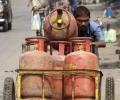
Indian govt must find solution to ever increasing LPG subsidy. Govt must cap LPG subsidy.

India's economy is likely to grow by 12 per cent in 2021 following a 7.1 per cent contraction last year, as near-term prospects have turned more favourable, Moody's Analytics said. A stronger than expected December quarter GDP growth of 0.4 per cent following a 7.5 per cent contraction in the previous three months has turned India's near-term prospects more favourable, it said. Domestic and external demand has been on the mend since the easing of restrictions, which has led to improved manufacturing output in recent months.
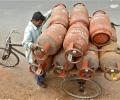
To cut subsidy bill and reduce fiscal deficit, the previous United Progressive Alliance government had restricted the number of subsidised domestic cylinders per household to six every year in September 2012, revising it to nine the following January
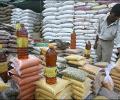
Of all the pulses, tur appears to be the most desired.

Experts say the party is undoing what it achieved through MNREGA by targeting beneficiaries

Indian billionaires saw their combined fortunes more than double during the COVID-19 pandemic, and their count shot up by 39 per cent to 142, while the wealth of the ten richest is enough to fund school and higher education of children in the country for 25 years, a new study showed on Monday. In its annual inequality survey released on the first day of the World Economic Forum's online Davos Agenda summit, Oxfam India further said that an additional one per cent tax on the richest 10 per cent can provide the country with nearly 17.7 lakh extra oxygen cylinders, while a similar wealth tax on the 98 richest billionaire families would finance Ayushman Bharat, the world's largest health insurance scheme, for more than seven years. The COVID-19 pandemic saw a huge rush for oxygen cylinders and insurance claims during the second wave last year.
Arguing that the recent elevation in retail inflation is not structural but supply-driven and therefore potentially transitory, a foreign brokerage report has forecast that the benign interest rate regime will continue at least until next June. The assessment comes a day ahead of the third bimonthly monetary policy review on Friday wherein it's widely expected that the monetary authority will leave the key rates unchanged at 4 per cent even though the consumer prices have been on remaining above 6 per cent since May and crude prices have been north of $70 a barrel for months.

Britain's prime ministerial candidate Rishi Sunak has said he wants to change the UK-India relationship to make it a more two-way exchange that opens up easy access to UK students and companies in India.

Postpone the purchase of big-ticket consumer durable items, recreational spending on holidays, and other such expenses unless your financial position is very secure, advises Sarbajeet K Sen.

The calculation is based on annual usage of eight cylinders per household.

The stellar rise in corporate earnings in financial year 2021-22 (FY21) and FY22 did not result in a corresponding boom in capital expenditure (capex), with listed companies' investment in fixed assets rising just 2.3 per cent year-on-year (YoY) in FY22, growing at the slowest pace in the last six years. In comparison, the firms' combined net profit jumped 63.5 per cent YoY in FY22, while net sales increased 31.1 per cent - the fastest pace in over a decade. The 955 non-financial companies in Business Standard's sample reported combined net profit of Rs 7.18 trillion in FY22, compared with Rs 4.39 trillion in FY21 and Rs 2.59 trillion in FY20.

Tax rules that could land you in trouble

What can households do with the old Rs 500 and Rs 1,000 notes? How can they find Rs 100 and smaller denominations?
Angus Deaton's Nobel Prize should spark off more research on the measurement and usefulness of poverty percentages.

While the likely intensity of the third wave is still a matter of debate, wisdom lies in being financially prepared for it, advises Bindisha Sarang.

As households age, they pile up debt, a peculiarity unique to Indians, a Financial Stability and Development Council report has found. Here are the key takeaways.

An interplay of Modi government's outreach in Bihar and the sequence of events in Chirag Paswan's life could make Bihar a game of musical chairs when the results are out.
Finance Minister Nirmala Sitharaman on Saturday announced increasing customs duty on imported footwear and furniture. In her second Budget presentation, the finance minister also imposed health cess on import of medical equipment.

Famous clay modeller Mintu Pal is sculpting the fibreglass idol at his Kumartuli studio draping the 'deity' in the Trinamool Congress supremo's favourite white coloured tant saree and her trademark flip-flop slippers to boot.

Prime Minister Modi has certainly pulled back, and his political capital -- dependent as it is on an image that he knows best and never retreats -- may have taken a bit of a beating. But, equally, it is hard to say that the protesters have 'won', argues Mihir S Sharma.
Moody's Investors Service on Friday slashed its estimate of India's GDP growth during the 2020 calendar year to 2.5 per cent from an earlier estimate of 5.3 per cent, on account of the rising economic cost of the coronavirus pandemic.

The government's predicament is a result of its own doing: That of not ensuring adequate buy-in by the stakeholders before passage of the laws, notes Vivek Gumaste.

The total worth of Assam Chief Minister Sarbananda Sonowal's assets, both movable and immovable, have increased by over 71 per cent since the last assembly polls in 2016, despite not having bought any new immovable assets.

China's economy picked up pace notching up 7.4 per cent year on year growth in the first half of 2014, the National Bureau of Statistics (NBS) said on Wednesday.

The study said India was the top receiving country for remittances in 2016 at USD 62.7 billion, followed by China (USD 61 billion), the Philippines (USD 30 billion) and Pakistan (USD 20 billion).

Gold loan companies offer loans to financially-excluded customers and MSMEs by enabling them to monetise their gold without the need for documentary proof of income

India's public debt ratio, which remarkably remained stable at around 70 per cent of the GDP since 1991, is projected to jump by 17 percentage points to nearly 90 per cent because of increase in public spending due to COVID-19, the IMF said.

India had 14 out of the world's 20 most polluted cities, the World Health Organization reveals.

Working hours cannot go beyond 48. Those who give a four-day week will have to provide three consecutive holidays after that.
'We are worried for the workers because in the private sector, jobs are not secure, there is no decent work condition and there is no social security.' 'That's why we are opposing the economic policies of this government.'
.jpg)
If we can come up with ways of sharing property rights on the internet, why not do something similar in urban spaces, asks Ajit Balakrishnan.

'From March 2020 to November 2021, the combined wealth of the billionaires of this country has doubled.'

India must do away with policy paralysis to ensure growth in agriculture.

Should deposit growth continue to outpace credit growth, banks may end up ceding some hard-earned 25-50 bps improvement in profitability or net interest margin gained in the past two years.

It raises three major questions - the incentive compatibility issue, the fairness issue and fiscal challenge, said Panagariya.

Inflation and asset prices have eroded the value of money.

Home buyers should look at smarter options before taking a loan.

About 20.8 per cent elders have lost either family members or friends due to COVID-19 and most of them believe that a better medical and health infrastructure could have saved these lives, according to a report that surveyed 3,526 elderly people in the country.
India lifted 271 million people out of poverty between 2006 and 2016, recording the fastest reductions in the multi-dimensional poverty index values during the period with strong improvements in areas such as "assets, cooking fuel, sanitation and nutrition," a report by the United Nations said.

Agricultural incomes can be taxed without hurting farmers, as a substantial section - the small and marginal ones - will remain outside the tax net simply because their incomes are likely to be below the basic exemption limit of Rs 250,000 per annum that is extended to all taxpayers in India, finds out Ishan Bakshi.
 © 2026 Rediff.com - Advertise with us - Disclaimer - Privacy Policy - Sitemap - Feedback - About us - Terms of use - Grievances